Part 3: Understanding the Divisions: D1, D2, D3, NAIA, and JUCO in College Golf

Introduction
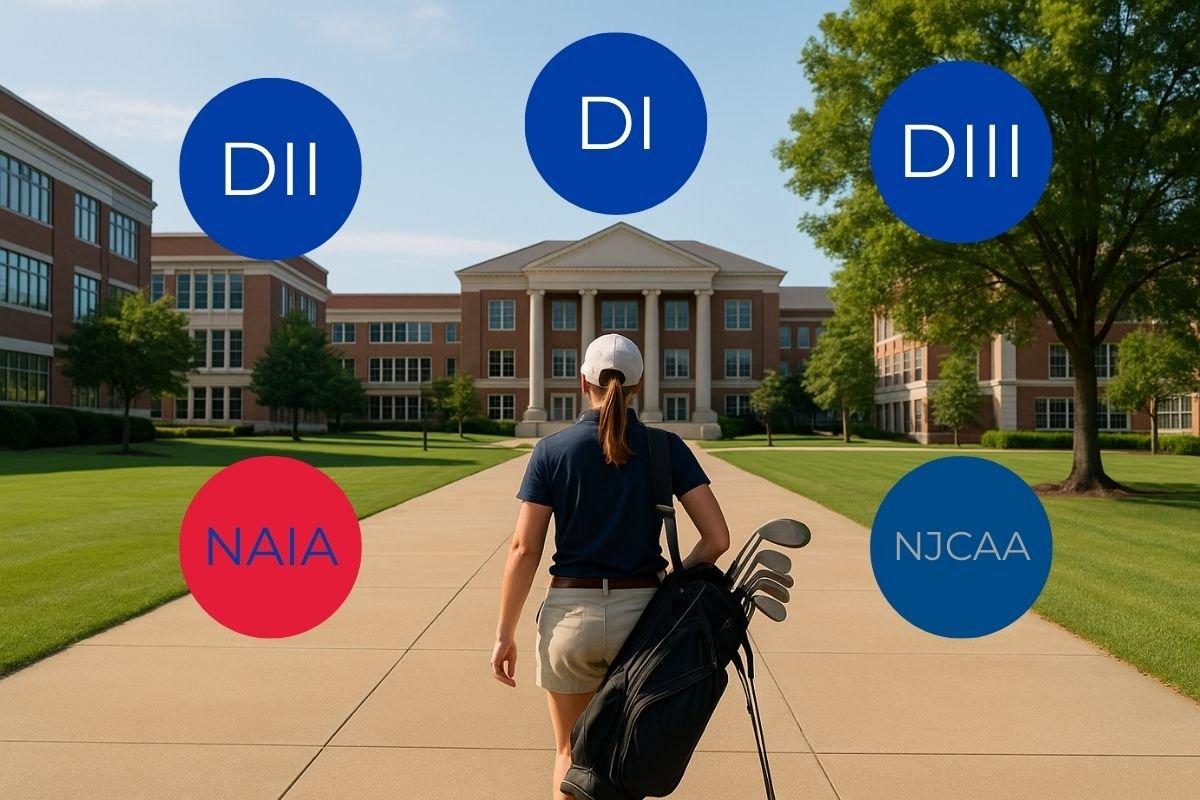
If you’ve followed the first two parts of our series, you already know what college golf is and how junior players can take the pathway from junior tournaments to college teams. But one big question remains: what kind of college golf are we talking about? Not every university competes on the same level. The U.S. system is divided into different “divisions,” and each one offers a unique balance between competition, academics, and scholarships.
For parents and players alike, understanding these divisions is crucial. It helps set realistic goals, prepares you for the recruiting conversation, and shows you where your daughter’s game might fit best. In this article, we’ll walk through all the main options: NCAA Division I, II, and III, as well as NAIA and Junior College (JUCO). We’ll also look at real scoring averages from championship events, so you can see the playing level each division demands.
NCAA Division I (D1)

When people imagine college sports in the U.S., they usually picture Division I. These are the largest schools, often with big athletic budgets, well-known campuses, and strong media coverage. In golf, Division I means competing against the very best — many players are on track to become professionals.
Until recently, Division I had strict limits on how many scholarships a women’s golf team could award (the old rule was 6). But in June 2025, the NCAA introduced a new system. Instead of fixed scholarship limits, there are now roster limits. That means a team can only carry a certain number of players (for women’s golf, around nine), but within that group the university may choose to fund scholarships for some or all of them, depending on the school’s budget. For top programs, this could mean more athletes receiving full funding; for others, financial packages may still be partial.
So what does it take to play at this level? The numbers tell the story. At the ACC Women’s Championship in 2025 (one of the strongest Division I conferences), the average score across the entire field was 74.8 on a par-72 course. At the NCAA Regional in Auburn (2024), the field average was 76.6. These are not just the best players on the leaderboard — that’s the whole field. To compete in Division I, you need to be capable of shooting mid-70s or better on challenging, championship-level courses.
NCAA Division II (D2)

Division II often flies under the radar, but it’s a fantastic option for many players. The golf is strong — some programs are nearly as competitive as mid-level Division I teams — but there’s usually a better balance between sports and academics. Class sizes are smaller, travel schedules can be lighter, and coaches often emphasize overall student-athlete well-being.
Scholarship rules here still work on the “equivalency” model. That means a team has a certain number of scholarships to divide among all players. In women’s golf, the official maximum is 5.4 scholarships per team. A coach might use that to give five players a full ride and one a partial, or spread the budget across the whole roster.
Performance standards vary. At the NCAA D2 West Regional in 2024, the field average was 75.1 — very close to a strong Division I regional. On the other hand, at the GNAC Conference Championship in 2025, the average was closer to 79.9. That shows the range: the top end of Division II is very competitive, but the overall level allows for a broader set of players. If you’re regularly shooting in the mid to high 70s, many Division II teams could be a realistic target.
NCAA Division III (D3)

Division III is very different. Here, the focus is on academics first. By rule, D3 schools do not award athletic scholarships at all. Instead, financial aid comes from academic merit, need-based grants, or other sources. For some families, that can still add up to significant support, but it won’t be tied directly to golf performance.
Does that mean the golf is casual? Not at all. The coaching is serious, the players are motivated, and national championships are competitive. At the 2024 NCAA D3 Women’s Championship, the average score was 79.7 across more than 460 rounds. That’s a clear sign that many players are still shooting in the 70s and competing at a solid level, though not quite the depth of Division I or II.
Division III is often the right fit for students who want a strong academic experience at a selective university but also want to keep competing in golf throughout college.
NAIA
The NAIA (National Association of Intercollegiate Athletics) runs its own system, separate from the NCAA. Many NAIA schools are smaller, and the competition level can vary widely. For international students, the NAIA is often attractive because of its flexibility in recruiting and admissions.
Scholarships are available, usually with a maximum of five per women’s golf team, but again these can be split up. NAIA coaches often combine athletic aid with academic scholarships to build a strong package.
While public scoring statistics are not as consistently archived as in the NCAA, many NAIA national tournaments show players shooting between mid-70s and low-80s. This makes the NAIA a strong option for players who are late developers, international recruits, or those who value a smaller-campus experience.
Junior College (JUCO)

Finally, there’s the Junior College (JUCO) pathway, governed by the NJCAA. JUCO schools are two-year colleges where athletes can study, compete, and then transfer to a four-year university. This option is especially valuable if you need more time to improve your golf game, strengthen your academics, or adjust to living in the U.S.
JUCO women’s golf programs are allowed up to eight scholarships per team, depending on the school. The level of play varies a lot, but the key advantage is opportunity. Many successful Division I or II athletes actually began at a junior college, used those two years to build experience and lower their scoring average, and then transferred to a bigger program.
Scoring data is harder to generalize because JUCO fields are diverse, but championship-level events often look similar to NAIA: averages in the high 70s to low 80s, with standout players going much lower.
Putting it all together
Here’s a simple way to think about it:
- Division I: The very best, often future professionals. You need to shoot mid-70s or better consistently.
- Division II: High-level golf with balance. Many strong players in the mid to high 70s.
- Division III: No athletic scholarships, but still competitive. High 70s to low 80s common in championships.
- NAIA: Flexible, international-friendly, smaller schools. Wide scoring range, often mid-70s to 80s.
- JUCO: Two-year stepping stone. Great option for players developing their game. Typically upper 70s to 80s fields.
The most important takeaway is that there’s a place for almost every level of player. You don’t need to be shooting under par every round to find a great college golf experience. What matters is knowing where your game stands today, where you want to grow, and which type of program fits your academic and athletic goals.