Part 2: The Pathway from Junior Golf to College Teams (Girls Edition)


In Part 1 we focused on the big picture. Now it’s all about execution: which tournaments matter, how WAGR really works, how to get on coaches’ radar—even if you’re not on a national team—and how to use round analysis to sharpen your edge.
1) Which tournaments actually matter?
a) National events
Your backbone should be multi-round, championship-style events—German Youth Championships (AK 14/16/18), their qualifiers, and recognized ranking events organized by your national golf federation (for Germany: DGV, in other countries the equivalent body). They’re predictable, well-run, and give coaches what they want: performance over several rounds under pressure.
b) International junior events (Europe & USA)
Target WAGR-counting junior events with 54+ holes and real field strength. Examples include:
- EGA / R&A junior championships and elite opens
- Global Junior Golf (GJG) tournaments across Europe—great circuit depth and calendar density
- AJGA events in the U.S., especially Invitationals, if you can get in

Why international events matter: Coaches want to see you compete outside your home country. It shows you can travel, adapt to new environments, and handle different course conditions (links, wind, heat, firm greens). Those experiences also build resilience—you learn to score when everything feels unfamiliar.
c) Club & team golf
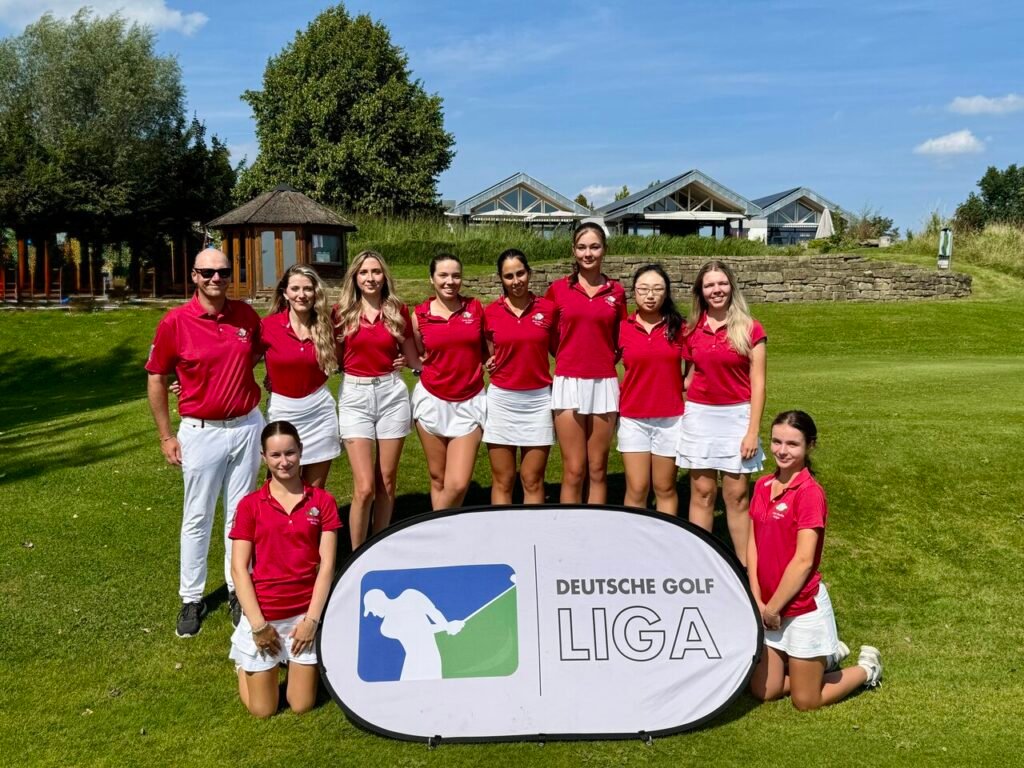
If you play in strong club team leagues (e.g., DGL), that’s a plus. Coaches like athletes who can contribute in team formats from day one.
2) WAGR—what coaches really read (and what they don’t)
What it is: The World Amateur Golf Ranking® aggregates results from approved “counting” events over a rolling period. Recent results carry more weight; field strength and course difficulty matter. There is a dedicated women’s ranking.
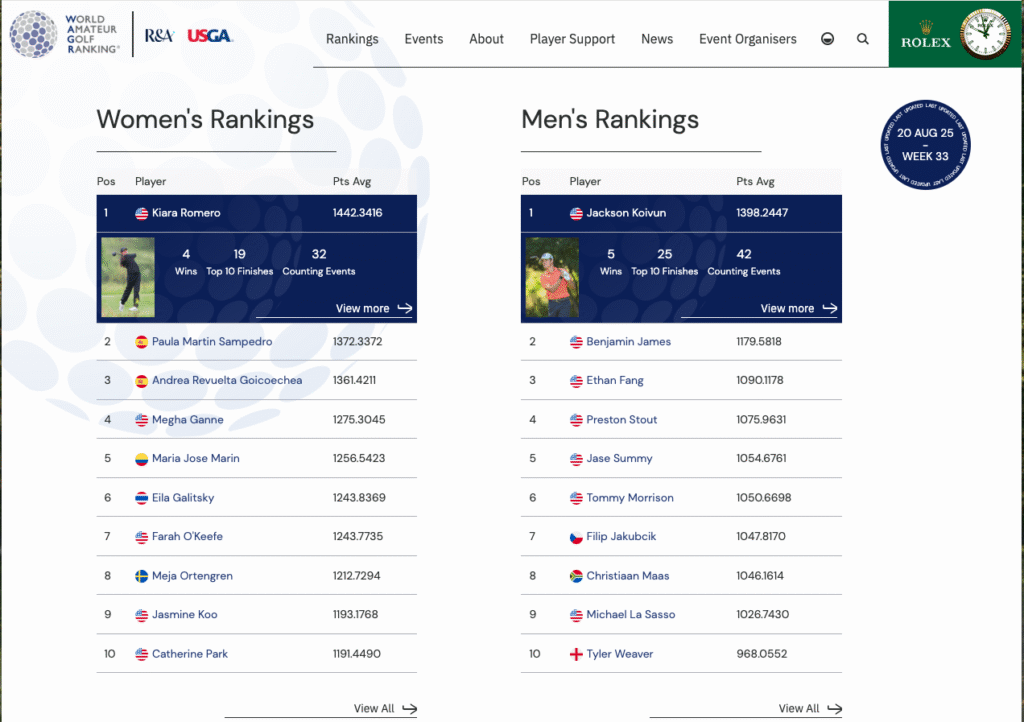
What matters to a coach:
- Your trajectory (last 6–12 months) vs. a one-off hot week
- Context of scores (course rating, conditions, field strength)
- Results in 54/72-hole events vs. random 18-hole opens
How to get listed initially:
You need points from approved events. Reality check: at typical/“normal” field strengths, you often need to win to earn enough points to be listed. That’s why early in your journey, it can be smart not to chase only the strongest fields—choose events where a top-1/top-3 is realistic. As your form stabilizes, scale into tougher fields.
Season design tip: Build around 3–5 “anchor” events (WAGR-counting, good fields), then add prep tournaments that sharpen specific skills (e.g., links winds, firm greens) without beating up your schedule.
3) European Golf Rankings by Ted Long — very useful before (and alongside) WAGR
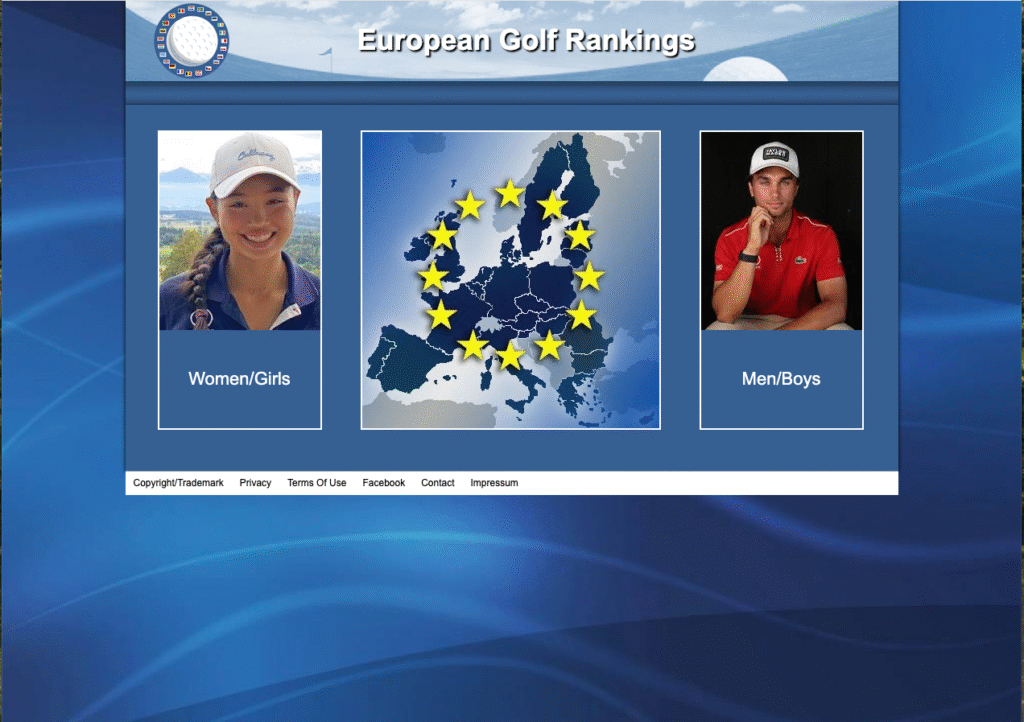
Until you’re on WAGR, (and even after), European GolfRankings (EGR) by Ted Long is a helpful visibility and benchmarking tool:
- Why it helps: It aggregates European junior results and creates a comparative picture when WAGR points are hard to get early on.
- How to use it:
- Make sure your profile is complete and results are captured correctly.
- Reference your EGR position and top finishes in coach emails while you’re building WAGR status.
- Track progression month-to-month; coaches love steady upward trends.
- Mindset: EGR is not a substitute for WAGR—but it’s a credible bridge and a simple way to show you’re moving in the right direction.
4) How to get coaches’ attention (without shouting)

A) Competition résumé (clean, compact, verifiable)
- Stroke average by season + trend (last 10–20 tournament rounds)
- Best finishes with field size, par, course rating / slope, and whether it was WAGR-counting
- Full scorecards (front/back totals) for major results
- 1-page player card: name, grad year, school subjects/grades, languages, height, club, coach, contact info
B) Video (2–3 minutes, high signal, no fluff)
- Face-on and down-the-line: wedge, iron, driver (4–6 swings each)
- Short game: 20–40m pitch, bunker, three putt distances
- On-course: 2–3 shots showing your full routine (not just range highlights)
- Subtle lower-thirds with handicap / top results / WAGR/EGR links
C) Social media (professional, useful, calm)
- Use Instagram/YouTube as your archive, not a hype machine.
- Post 30–60s tournament recaps, training clips with measurable goals (“8/10 up-and-downs today”).
- Keep your profile public but tidy; let it reflect team spirit and consistency.
D) Outreach (be precise and coach-friendly)
- Build a target list (10–20 programs) that fit your academic goals and playing level.
- Send a concise intro email (≤10 sentences): who you are, 3 key results, WAGR/EGR links, video, academics, intended start term.
- Follow up after real progress (new personal bests, top finishes).
- On calls: ask about qualifying formats, practice structure, role as freshman, academic support.
Important note: Prepare everything (résumé, video, stats) and keep your data updated. But when the time comes to actively engage with schools, it can make sense to go through an agency or trusted intermediary. Two that I can personally recommend: Ted Long (EGR, deep European and U.S. network) and Scholarbook (broad U.S. placement experience). A good intermediary adds credibility and can open doors faster.
5) Round analysis & stats—how you prove you’re coachable

Raw score is the headline; process metrics win the interview.
What to track (core set):
- Strokes Gained (or a proxy) Tee-to-Green / Approach / Short Game / Putting
- Fairways hit (but emphasize miss pattern and penalty shots)
- Greens in Regulation + Proximity buckets (e.g., 80–120m, 120–160m)
- Up-and-down % (incl. bunker split)
- 3-putt rate and first-putt make/two-putt probabilities by distance
- Error taxonomy: tactical (club/target), technical (pattern), mental (decision speed, routine)
Tools to consider that get the job done for you: bebrassie, DECADE, Upgame.
- bebrassie: fast post-round logging and clean dashboards.
- DECADE: course-management system to tighten targets and reduce “big numbers.”
- Upgame: training plans plus performance tracking in one ecosystem.
How to present it: One slide with “Before vs. After” (e.g., 3-putt rate from 8% → 4%, SG:Approach +0.6/rd). Attach a 30-day action plan (e.g., “30 balls/day from 110–130m, landing window 8m; weekly 9-hole DECADE gameplan”). That screams coachability.
6) Motivation: You don’t need a national team badge
Plenty of D1/D2/D3/NAIA/JUCO programs recruit developmental players who are trending up, disciplined, and academically reliable. Your job: show an upward slope, real tournament hardness, and the willingness to learn fast.
7) A simple age-based roadmap (guideline, not a rule)
Here’s what the journey can look like if you’re aiming for college golf. (Note: “U15” means you are under 15 years old, i.e. 14 or younger in that calendar year.)
- 14 and under: Build your technical foundation and short-game volume. Start playing multi-round events nationally.
- 15 years old: Target your first WAGR-counting events. Add one or two international starts (e.g., GJG, EGA junior opens).
- 16 years old: Establish anchor events with field strength. Update your recruiting video. Begin structured outreach to coaches.
- 17 years old: Confirm results, strengthen academics, manage calls/visits, and finalize your pathway into college.
8) Your next five moves

- Lock a 12-month schedule with 3–5 anchor events (WAGR-counting where possible) and add GJG/EGA/AJGAoptions that suit your current level.
- Build a results dossier (PDF/Drive): scorecards, stroke average, best finishes, course-context notes.
- Film a 2–3 min recruiting video (technique + short game + on-course).
- Create your EGR (Ted Long) profile or make sure it’s accurate; include it in coach emails until WAGR kicks in.
- Start round analysis immediately (bebrassie / DECADE / Upgame) and add one slide of insights to your player card.